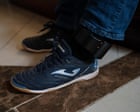
Nearly 54,000 immigrants across the United States are currently carrying a constant reminder of federal surveillance on their legs. GPS-enabled ankle monitors have quietly become a centerpiece of federal immigration enforcement. This isn't an accident. It's the result of a deliberate operational shift that trades human freedom for corporate revenue.
Data revealed during a recent earnings call by private prison firm The Geo Group exposes a stark reality. While total enrollment in Immigration and Customs Enforcement tracking programs remains flat at roughly 184,000 people, the composition of that surveillance has changed dramatically. ICE has systematically forced thousands of people off cheap phone check-ins and onto heavy, intrusive GPS shackles.
Early last year, only about 17,000 immigrants wore these devices. Today, that number has tripled. Behind this massive expansion lies a lucrative financial arrangement that rewards private contractors for keeping people tethered.
Following the Money Behind the Monitors
The mechanics of this surveillance economy are straightforward. The Geo Group owns BI Inc, the subsidiary that manages ICE's Intensive Supervision Appearance Program, commonly known as ISAP. Under current federal outlays, an ankle monitor costs taxpayers a little over two dollars a day per person.
Compare that to the SmartLink smartphone application, which uses facial recognition and basic location tracking for roughly ninety-six cents a day. More than 127,000 people still use the app, but the agency's internal push has heavily favored physical hardware.
Geo Group executives made their financial priorities crystal clear to investors. Shifting participants from software check-ins to physical hardware directly boosts corporate revenues. When internal memos direct deportation officers to escalate supervision levels without individual risk assessments, private balance sheets grow.
The corporate incentive structure thrives on expansion. At the start of last year, Geo Group invested sixteen million dollars into manufacturing infrastructure to scale up production. They built the capacity to track hundreds of thousands, or even millions, of participants if federal policy demands it.
The Human Toll of Constant Surveillance
Ankle monitors do more than track geographic coordinates. They actively disrupt daily existence. The hardware is bulky, heavy, and stigmatizing. Devices require daily charging sessions that trap wearers near wall outlets for hours at a time. Many individuals report skin irritation, burns from overheating equipment, and device malfunctions that trigger false alarms.
Finding or maintaining employment becomes an uphill battle. Employers hesitate to hire workers whose physical movements are visibly restricted or who must suddenly leave to charge a tracking shackle. Psychological pressure builds quickly. Constant surveillance fosters a persistent sense of criminalization among people who have never been convicted of a crime.
Advocacy organizations point out that this psychological grind serves a distinct purpose. Forcing individuals into uncomfortable, restrictive conditions pushes some people toward self-deportation. When everyday life becomes unbearable, the system achieves its removal goals without needing scarce detention beds.
Pushing Back Through the Courts
Civil rights attorneys are fighting back against what they term an unauthorized policy of monitors for all. A class action lawsuit filed against ICE argues that continuous GPS tracking violates basic legal standards. The suit challenges the lack of individualized justifications, noting that people receive tracking devices arbitrarily, regardless of their compliance history or flight risk.
Internal agency documents leaked to the press show that the surge in physical shackles stems from top-down directives rather than case-by-case evaluations. When transparency fails, litigation remains one of the few tools available to check corporate-driven enforcement strategies. Organizations like the Amica Center continue to demand public release of the directives governing these surveillance expansions.
What to Do If You or a Family Member Faces Monitoring
Navigating the alternatives to detention program requires strict adherence to complex rules. A single technical glitch can result in severe legal consequences.
- Maintain meticulous records of every device charge, check-in, and notification.
- Report equipment malfunctions immediately to both the monitoring contractor and your legal representative.
- Keep emergency contact logs if battery failures occur due to power outages or hardware faults.
- Consult an experienced immigration attorney before attending mandatory check-ins if any compliance warnings were triggered.
Electronic monitoring is supposed to be an alternative to locking people away in detention cells. Instead, it has morphed into a digital cage that generates millions of dollars for private prison corporations while stripping basic dignity from tens of thousands of people.