Mega-infrastructure projects usually leave behind mountains of waste and exhausted landfills. Virginia decided to do something radically different with its highway rubble.
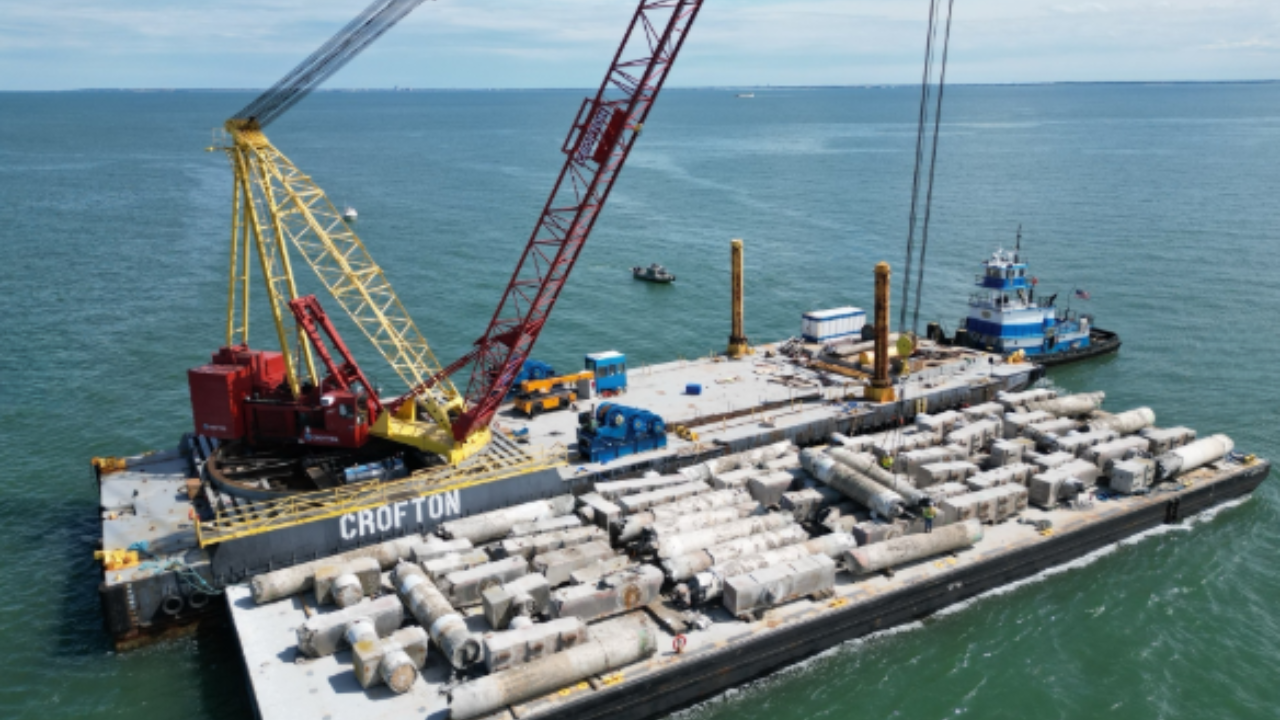
Workers tearing apart decades-old infrastructure for the massive $3.9 billion Hampton Roads Bridge-Tunnel expansion aren't just hauling the debris to local dumps. Instead, heavy barges are shipping massive chunks of old bridge decks, beams, and concrete foundations offshore to sink them straight into the Chesapeake Bay. Out of an expected 100,000 tons of slated demolition material, nearly a thousand tons are already resting on the seabed as thriving new homes for marine species.
If you've ever wondered what happens to the skeleton of an aging highway system when it gets replaced, the answer is happening right now off the coast of Virginia.
The Logistics of Sinking a Bridge
Crushing and hauling thousands of tons of concrete sounds simple on paper. In practice, moving massive structural blocks weighing up to 50,000 pounds requires extreme precision.
Contractors load the salvaged concrete directly onto barges. Once the vessels reach permitted offshore locations like the Bluefish Rock Reef—situated about four miles east of Buckroe Beach—heavy cranes use specialized block-and-pulley setups to lower the material onto the bay floor.
You can't just toss debris into the water and hope for the best. Ryan Banas, the project director for the Virginia Department of Transportation, notes that meticulous planning keeps everything on track. Marine experts deploy three-dimensional imaging technology to map the seabed. This guarantees that every single slab lands exactly where it needs to be, avoiding navigation hazards for commercial boats and recreational vessels while satisfying strict environmental regulations.
Engineering an Ecosystem From Highway Scrap
Dead concrete might look like lifeless grey dust on land, but it transforms underwater.
When heavy blocks hit the ocean floor, they create complex hard-surface relief structures in areas dominated by flat sediment. Hunter Smith, an artificial reef specialist with the Virginia Marine Resources Commission, explains that these solid underwater surfaces give microorganisms something to cling to immediately.
Tiny barnacles, algae, and mussels colonize the concrete first. Small baitfish follow close behind to feed and hide from strong currents and hungry hunters. Within a short window, larger predators like black sea bass, tautog, flounder, and red drum move into the area.
Virginia's artificial reef initiative isn't a brand-new experiment. The state's marine commission has managed dozens of reef sites across coastal waters and the Chesapeake Bay since the 1960s, originally using decommissioned World War II Liberty ships before transitioning to durable construction materials.
Why This Re-Use Strategy Makes Sense
Landfill space is finite, expensive, and environmentally taxing to maintain. Diverting 100,000 tons of heavy bridge debris away from local disposal sites prevents massive waste burdens.
While state officials haven't published an exact dollar figure for how much money this diversion saves taxpayers on disposal fees, the logistical win is obvious. Material that has to be broken down anyway gets repurposed into a self-sustaining biological engine.
Anglers and local fishermen also reap the rewards. The Virginia Marine Resources Commission maintains detailed digital maps of these artificial reef sites, turning transit waste into hotspots for recreational fishing.
The Hampton Roads expansion project won't finish wrapping up until 2027, meaning the vast majority of that 100,000-ton concrete mountain is still waiting to be repurposed. As traffic shifts permanently onto the newly constructed lanes, demolition activity will ramp up, sending a steady stream of heavy slabs straight to the ocean floor.
Old infrastructure always has to go somewhere when its time is up. Virginia is proving it doesn't have to rot away in a landfill to do it.